Constructed Relaxation Is Unbounded
Consider the following bilinear quadratic program,min x1x7+x2x8-x1+x5-x6s.t. X1+x2=1,-x3+x5-x6+x7=0,-x4+x5-x6+x8=0,x1, x2, x3, x4, x5, x6=0,x7, x8=1.Its optimal value is -1, consider (1,0,0,0,0,1,1,1).
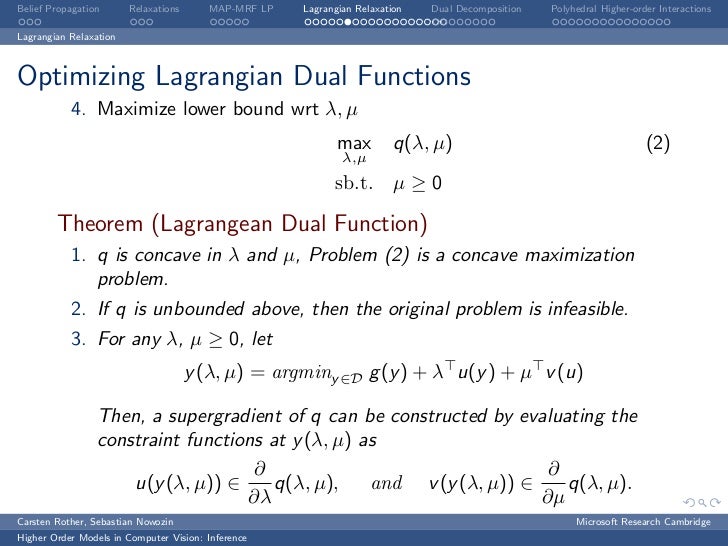
When I model this problem via cplexqp (opt.optimalitytarget=3) on MATLAB, surprisingly, it announces the problem is unbounded. Of course, the problem is bounded, because objective function can be written as follows (consider multiplication of second and third constraint by x 1 and x 2, respectively)x1x7+x2x8-x1+x5-x6=-x1+x1x3+x2x4.I used global solver cplexqp many times and always provided the best solution compared to the other solvers. I wonder why it cannot handle this problem. My CPLEX version is 12.8. Hi sorry for the long time to answer,I ran the model in matlab and the status I get is:statusstring: 'constructed relaxation is unbounded'which is legitimate in that case.Most global solver don't have this status. For an indefinite quadratic optimization problem, it may happen that the convex relaxation we construct is unbounded.
From that point, one can try to solve the model anyway as is. It may succeed (like in this case aparently with YALMIP) but it may also leads to something that looks a lot like an infinite loop (it is relatively easy to construct examples).The simplest workaround is to put some reasonnable large bounds (here on the variables x7 and x8).I have put bounds of 1e4, the solve with CPLEX unfortunately still has difficulties to converge. There are also some issues in reporting: in the log CPLEX reports solution of cost slightly lower than -1 but those are round off errors.We will try to fix all these in the future.
Hi sorry for the long time to answer,I ran the model in matlab and the status I get is:statusstring: 'constructed relaxation is unbounded'which is legitimate in that case.Most global solver don't have this status. For an indefinite quadratic optimization problem, it may happen that the convex relaxation we construct is unbounded. From that point, one can try to solve the model anyway as is. It may succeed (like in this case aparently with YALMIP) but it may also leads to something that looks a lot like an infinite loop (it is relatively easy to construct examples).The simplest workaround is to put some reasonnable large bounds (here on the variables x7 and x8).I have put bounds of 1e4, the solve with CPLEX unfortunately still has difficulties to converge.
Constructed Relaxation Is Unbounded 1
There are also some issues in reporting: in the log CPLEX reports solution of cost slightly lower than -1 but those are round off errors.We will try to fix all these in the future. Hi sorry for the long time to answer,I ran the model in matlab and the status I get is:statusstring: 'constructed relaxation is unbounded'which is legitimate in that case.Most global solver don't have this status. For an indefinite quadratic optimization problem, it may happen that the convex relaxation we construct is unbounded. From that point, one can try to solve the model anyway as is.
Constructed Relaxation Is Unbounded 3
It may succeed (like in this case aparently with YALMIP) but it may also leads to something that looks a lot like an infinite loop (it is relatively easy to construct examples).The simplest workaround is to put some reasonnable large bounds (here on the variables x7 and x8).I have put bounds of 1e4, the solve with CPLEX unfortunately still has difficulties to converge. There are also some issues in reporting: in the log CPLEX reports solution of cost slightly lower than -1 but those are round off errors.We will try to fix all these in the future.
Consider the following bilinear quadratic program,min x1x7+x2x8-x1+x5-x6s.t. X1+x2=1,-x3+x5-x6+x7=0,-x4+x5-x6+x8=0,x1, x2, x3, x4, x5, x6=0,x7, x8=1.Its optimal value is -1, consider (1,0,0,0,0,1,1,1). When I model this problem via cplexqp (opt.optimalitytarget=3) on MATLAB, surprisingly, it announces the problem is unbounded. Of course, the problem is bounded, because objective function can be written as follows (consider multiplication of second and third constraint by x 1 and x 2, respectively)x1x7+x2x8-x1+x5-x6=-x1+x1x3+x2x4.I used global solver cplexqp many times and always provided the best solution compared to the other solvers. I wonder why it cannot handle this problem. My CPLEX version is 12.8.
Hi sorry for the long time to answer,I ran the model in matlab and the status I get is:statusstring: 'constructed relaxation is unbounded'which is legitimate in that case.Most global solver don't have this status. For an indefinite quadratic optimization problem, it may happen that the convex relaxation we construct is unbounded. From that point, one can try to solve the model anyway as is. It may succeed (like in this case aparently with YALMIP) but it may also leads to something that looks a lot like an infinite loop (it is relatively easy to construct examples).The simplest workaround is to put some reasonnable large bounds (here on the variables x7 and x8).I have put bounds of 1e4, the solve with CPLEX unfortunately still has difficulties to converge. There are also some issues in reporting: in the log CPLEX reports solution of cost slightly lower than -1 but those are round off errors.We will try to fix all these in the future. Hi sorry for the long time to answer,I ran the model in matlab and the status I get is:statusstring: 'constructed relaxation is unbounded'which is legitimate in that case.Most global solver don't have this status. For an indefinite quadratic optimization problem, it may happen that the convex relaxation we construct is unbounded.
From that point, one can try to solve the model anyway as is. It may succeed (like in this case aparently with YALMIP) but it may also leads to something that looks a lot like an infinite loop (it is relatively easy to construct examples).The simplest workaround is to put some reasonnable large bounds (here on the variables x7 and x8).I have put bounds of 1e4, the solve with CPLEX unfortunately still has difficulties to converge. There are also some issues in reporting: in the log CPLEX reports solution of cost slightly lower than -1 but those are round off errors.We will try to fix all these in the future. Hi sorry for the long time to answer,I ran the model in matlab and the status I get is:statusstring: 'constructed relaxation is unbounded'which is legitimate in that case.Most global solver don't have this status. For an indefinite quadratic optimization problem, it may happen that the convex relaxation we construct is unbounded. From that point, one can try to solve the model anyway as is.
It may succeed (like in this case aparently with YALMIP) but it may also leads to something that looks a lot like an infinite loop (it is relatively easy to construct examples).The simplest workaround is to put some reasonnable large bounds (here on the variables x7 and x8).I have put bounds of 1e4, the solve with CPLEX unfortunately still has difficulties to converge. There are also some issues in reporting: in the log CPLEX reports solution of cost slightly lower than -1 but those are round off errors.We will try to fix all these in the future.